
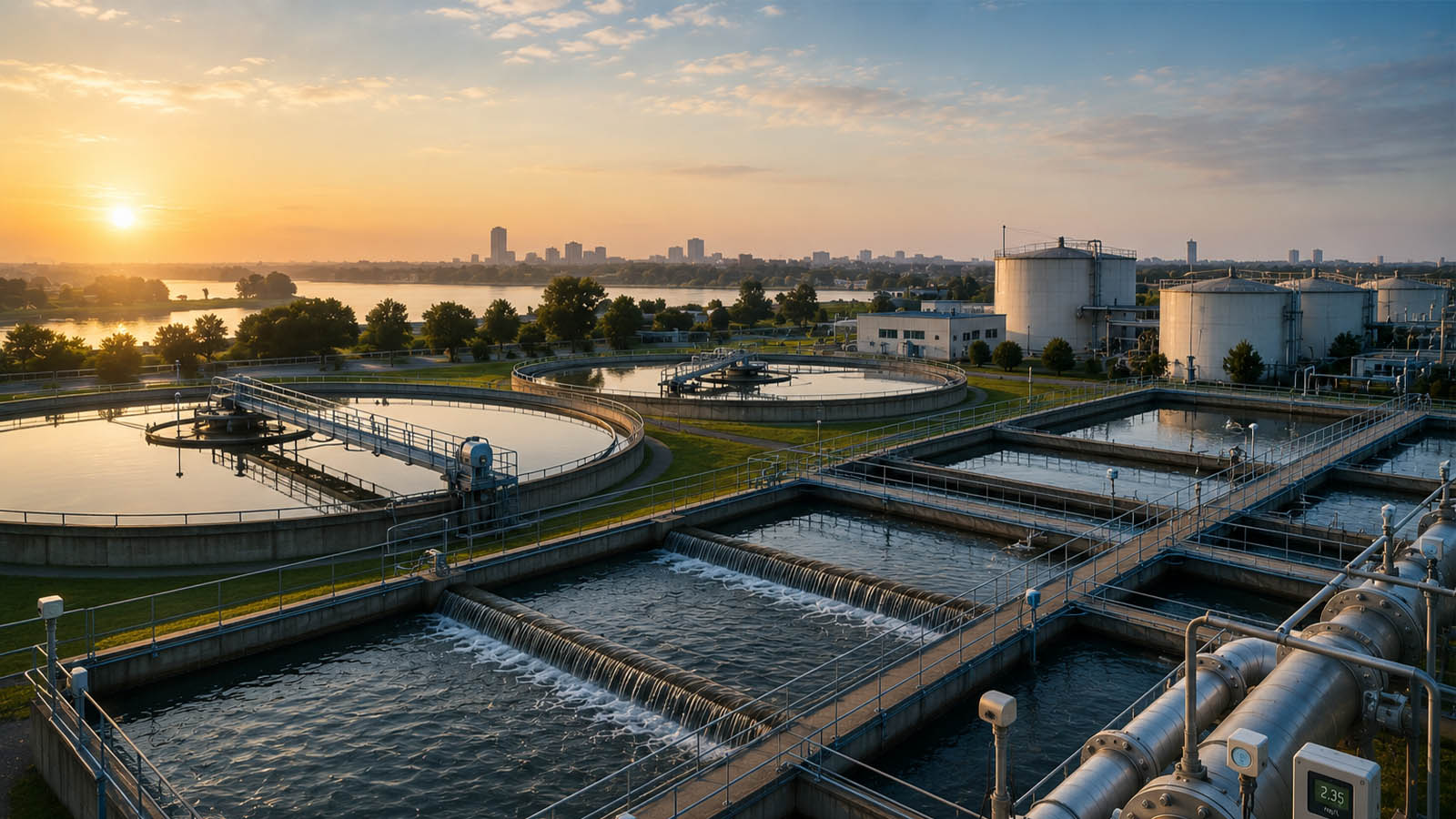
Water infrastructure was built to move and treat water. For decades, that was enough.
Treatment plants processed. Pumps distributed. Reservoirs stored. Operators inspected. The system worked because the variables were manageable — demand was predictable, regulations were stable, and manual oversight could keep pace with operational conditions.
That environment no longer exists.
Across the facilities and infrastructure environments Viosimo works in, a pattern repeats itself. Systems that were designed and built to specification are underperforming — not because of poor construction, but because of a fundamental gap between how infrastructure was designed and how it is expected to perform today. The physical systems exist. The intelligence layer does not.
This gap is where the real challenge in water infrastructure lies.
What changes when demand becomes complex
Industrial facilities drawing from shared water networks face pressure fluctuations that affect process continuity. Municipal systems managing ageing pipelines encounter losses that are difficult to locate without continuous monitoring. Water treatment plants operating under tightening compliance requirements need visibility into dosing, filtration, and discharge quality in real time — not through periodic manual checks.
In each of these environments, the consequences of delayed information are not minor. A pressure anomaly left undetected becomes a leak. A dosing irregularity left unchecked becomes a compliance failure. A treatment inefficiency left unmonitored becomes a resource loss that compounds over time.
The challenge is not a lack of infrastructure. It is a lack of awareness within infrastructure.
Intelligence as an operational layer
This is where Viosimo’s approach differs from conventional infrastructure thinking.
Most infrastructure projects are evaluated at completion. Once systems are operational, the focus shifts to maintenance cycles and reactive responses. Viosimo treats operational intelligence not as a post-construction addition, but as a foundational layer that must be integrated from the outset.
Real-time monitoring across flow, pressure, water quality, and system performance transforms infrastructure from a passive network into a responsive system. IoT-enabled sensors provide continuous visibility. Automated control systems reduce dependency on manual intervention. Data-driven analysis allows operators to identify patterns, anticipate issues, and make informed decisions before disruptions occur.
In water treatment environments specifically, this means automated chlorination systems that adjust dosing based on live water quality data rather than fixed schedules. In wastewater infrastructure, it means treatment processes that adapt to incoming load conditions, improving efficiency and reducing resource waste. In distribution networks, it means pressure monitoring that flags anomalies before they become failures.
These are not theoretical improvements. They are operational realities in facilities where intelligence has been properly integrated.
Visibility is not a feature — it is a responsibility
Water infrastructure supports environments where failure is not an option — industrial plants, hospitals, educational institutions, commercial complexes, and residential communities. In these settings, continuity is not a performance metric. It is a fundamental expectation.
What Viosimo consistently observes is that the facilities with the strongest operational records are not necessarily those with the newest physical infrastructure. They are the ones where operators have clear, continuous visibility into system behaviour. Where maintenance is driven by data rather than schedules. Where responses are measured in minutes rather than hours.
Visibility, in this context, is not a feature added to infrastructure.
It is a form of operational responsibility.
Water, sustainability, and the ecosystem perspective
Intelligent water infrastructure also changes the relationship between operations and sustainability — and this is a connection that Viosimo considers central, not secondary.
Traditional water systems were designed to deliver and treat. Sustainability was rarely embedded in the operational logic of the system itself. Today, the two cannot be separated. Undetected leakages represent resource loss at scale. Inefficient treatment processes consume energy and chemicals unnecessarily. Poor discharge monitoring creates environmental risk.
When infrastructure is intelligent, sustainability improves as a direct consequence of better performance — not as a separate initiative layered on top.
At Viosimo, water infrastructure, automation, monitoring, IoT integration, and sustainability are viewed as parts of a single interconnected ecosystem. Each element affects the others. A treatment system that monitors continuously performs more efficiently. A distribution network with pressure intelligence wastes less. A wastewater system with adaptive controls discharges more responsibly.
This is how Viosimo thinks about water infrastructure — not as isolated components to be built and handed over, but as living systems that must be designed to observe, adapt, and improve over time.
The infrastructure that thinks is the infrastructure that endures
The future of water infrastructure will not be defined by the scale of what is built. It will be defined by how intelligently what is built continues to perform.
Systems that can monitor themselves, respond to changing conditions, optimise resource use, and maintain operational continuity under pressure will outperform those that cannot — regardless of how well they were constructed.
Water infrastructure today must do more than operate.
It must observe.
It must respond.
It must sustain.
And for the environments that depend on it most, it must think.