
Infrastructure systems were once designed primarily for operation.
Water treatment plants processed water. Energy systems supplied power. Environmental systems managed compliance. Monitoring was manual, responses were delayed, and decision-making depended heavily on observation and intervention.
For decades, this approach was considered sufficient.
But infrastructure today operates in a very different environment.
Cities are expanding faster. Industries are becoming more dependent on uninterrupted systems. Environmental regulations are becoming stricter. Energy demand is fluctuating continuously. Water resources are under increasing pressure. At the same time, expectations around reliability, safety, efficiency, and sustainability continue to rise.
In this environment, infrastructure can no longer remain passive.
It must become intelligent.
Intelligence is not about technology — it is about awareness
The future of infrastructure depends not only on physical systems, but on how effectively those systems can monitor conditions, process information, respond to changes, and optimise performance in real time.
Intelligent infrastructure is not defined by technology alone. It is defined by awareness.
A system that can identify pressure changes in a water network before failure occurs is more resilient than one that reacts after damage is done. An energy system that balances generation, storage, and consumption dynamically is more reliable than one operating without visibility. Environmental systems that continuously monitor air or water quality create safer and more responsible operating environments.
The role of intelligence is therefore becoming central to modern infrastructure.
How intelligence is changing infrastructure systems
This shift is visible across nearly every infrastructure domain.
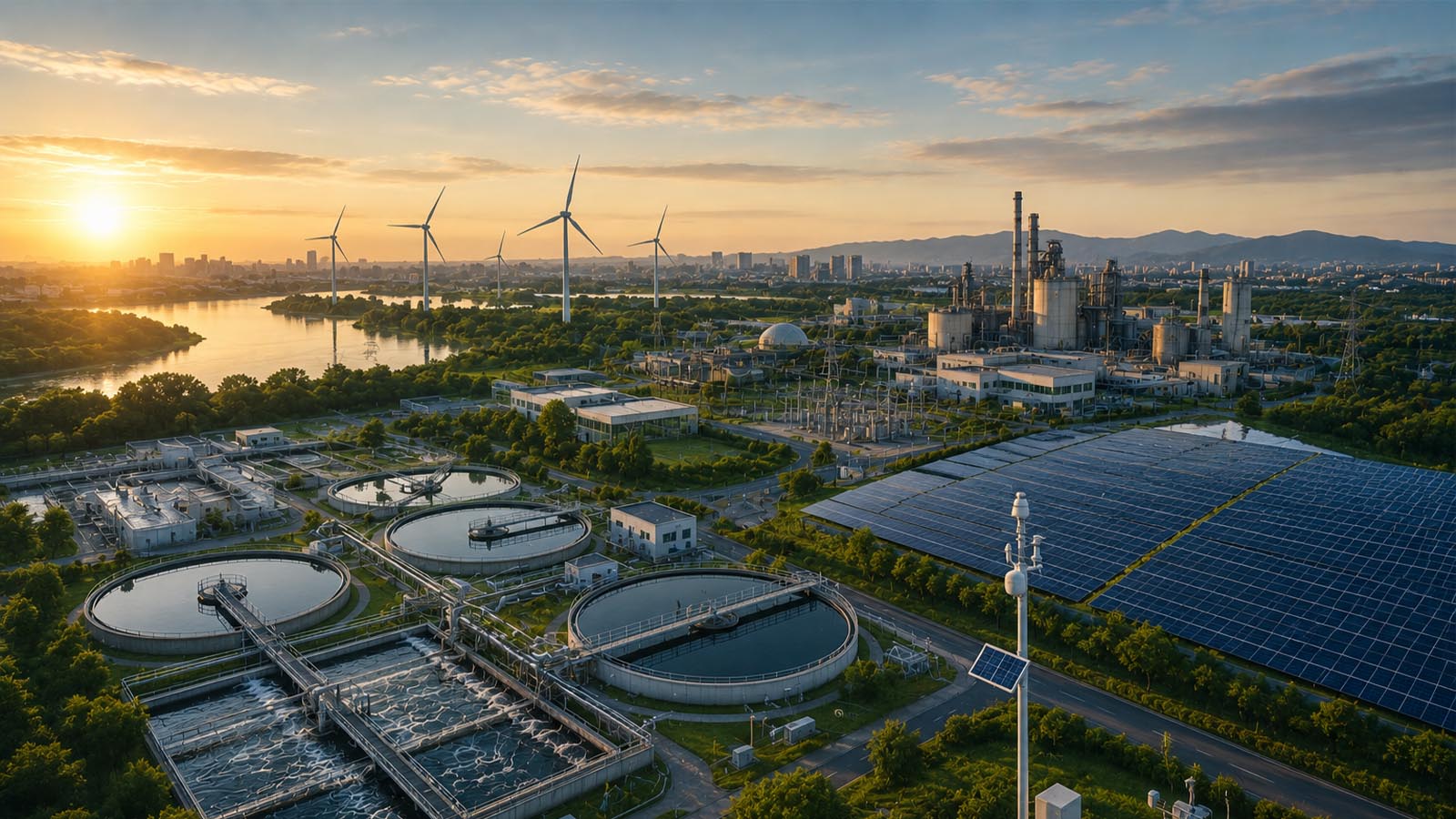
In water treatment systems, real-time monitoring and automated dosing systems improve operational precision while reducing risks associated with manual intervention. Sensors and IoT-enabled controls provide continuous visibility into system performance, helping operators maintain stability and respond faster to irregularities.
In renewable energy systems, intelligent monitoring enables energy production, storage, and distribution to function as an integrated ecosystem rather than isolated components. Solar infrastructure is increasingly connected with smart inverters, battery systems, and energy management technologies that improve efficiency and long-term performance.
Environmental infrastructure is also evolving rapidly through intelligent systems. Air purification technologies now integrate continuous monitoring and adaptive filtration controls. Pollution control systems rely on sensors, automation, and data-driven analysis to maintain compliance while reducing environmental impact.
These systems are not intelligent because they use technology. They are intelligent because they improve how infrastructure behaves over time.
The purpose of intelligence is clarity, not complexity
Technology alone does not create meaningful progress. Infrastructure becomes intelligent only when technology strengthens reliability, responsiveness, sustainability, and long-term operational stability.
The purpose of intelligent infrastructure is therefore not complexity.
It is clarity.
Clear visibility into system performance. Clear understanding of operational conditions. Clear responses to changing environments. Clear pathways toward efficiency and sustainability.
This is especially important in high-responsibility environments where system failure carries larger consequences.
Water infrastructure cannot afford uncertainty in monitoring. Industrial energy systems cannot depend entirely on unstable supply conditions. Environmental systems cannot rely on delayed responses to changing data. In such environments, intelligence becomes essential not for innovation alone, but for operational responsibility.
The Viosimo approach to intelligent infrastructure
At Viosimo, intelligent infrastructure is approached as an integrated relationship between engineering, monitoring, automation, and sustainability. Technology is applied where it creates measurable value — improving efficiency, reducing risk, strengthening system visibility, and enabling long-term resilience.
This approach extends across water treatment, renewable energy, environmental engineering, and smart infrastructure systems.
Infrastructure that observes, adapts, and thinks
Because infrastructure today must do more than operate.
It must observe.
It must adapt.
It must optimise.
And increasingly, it must think.
The future of infrastructure will not belong to isolated systems operating independently. It will belong to connected ecosystems where intelligence strengthens every layer of performance — from energy and water management to environmental responsibility and operational continuity.
As infrastructure becomes more interconnected, the role of intelligence will only become more important.
Not as an optional enhancement.
But as part of the foundation itself.